Wedding seating plan: how to seat your guests, with table layouts
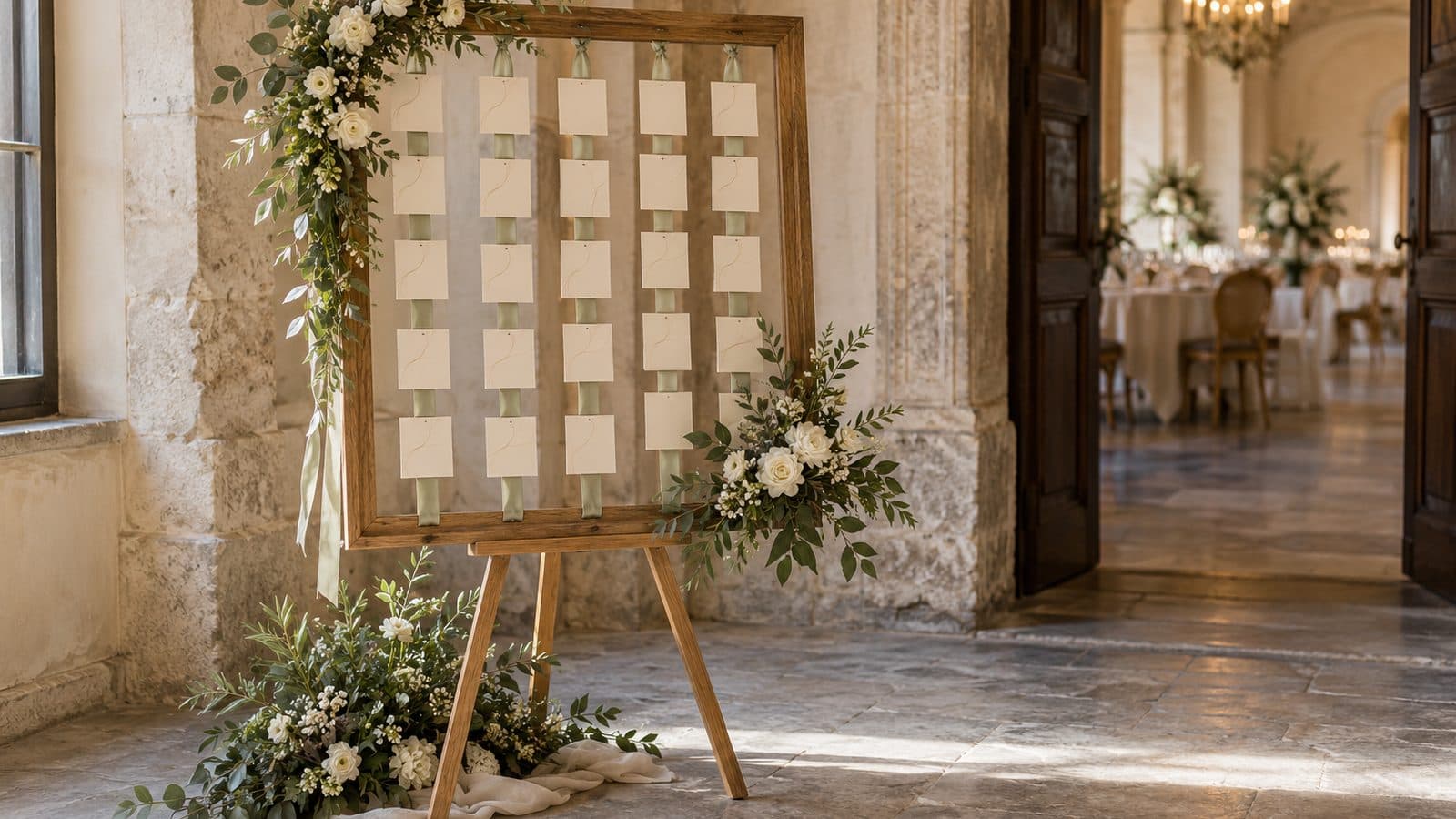
Make your seating plan once guests have confirmed, that is roughly four to six weeks before the wedding. Start with the top table and the family, then seat friends by group, and finally fine-tune the details: older guests away from the speakers, children with their parents, and people who don't get on at tables far apart. Give the final version to the venue and the caterer one to two weeks before the wedding.
In this article you will find how to go about it step by step, who sits at the top table, which tables to choose and three layouts for a wedding with 50 guests.
When to make the seating plan
Until guests have confirmed, the seating plan will keep changing. So:
- Set the RSVP deadline four to six weeks before the wedding. You will find how to put it in the invitation in the article Wedding invitations.
- Make the first version straight after the RSVP deadline.
- Fine-tune the final version one to two weeks before the wedding, once you also know about those who replied late.
- Hand it over to the venue and the caterer, together with the number of people at each table and any dietary needs.
Round or long tables?
| Round tables | Long tables | |
|---|---|---|
| How many people | a 150 cm table for 8 guests, 180 cm for 10 | about 60 to 70 cm of table length per person |
| Atmosphere | small groups chatting together | one big family, a feast-like feel |
| Space | need more room in the hall | fit into narrower spaces too, such as a barn |
| Seating plan | easier, you divide guests by group | harder, both neighbours and the people opposite matter |
| Service | plated service and a buffet | also good for sharing platters in the middle of the table |
Don't decide just from photos. Ask the venue what tables they have and how many fit into the hall. An empty barn and a château hall offer completely different possibilities.
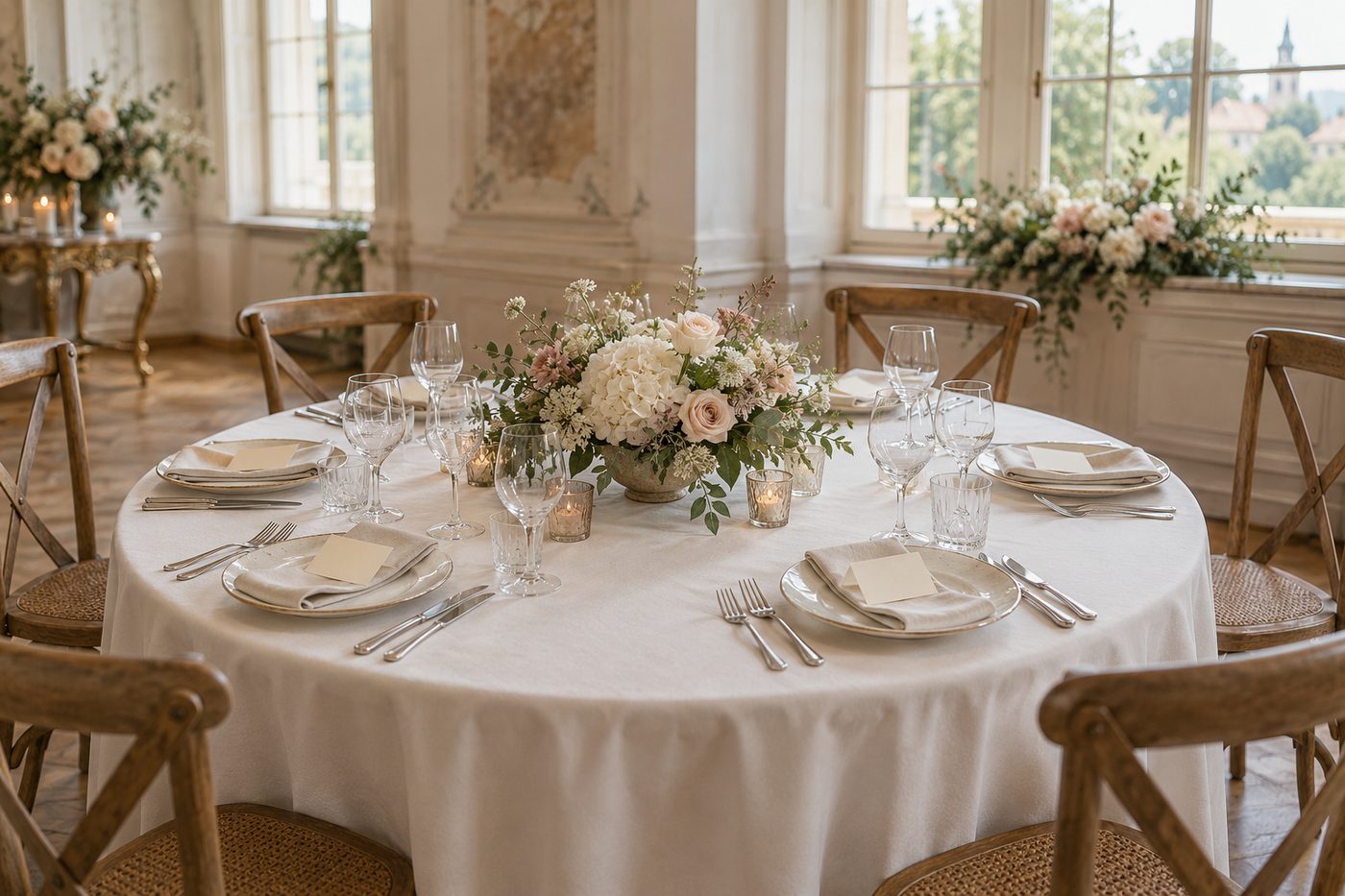 Eight guests fit comfortably around a 150 cm round table.
Who sits at the top table
The top table is the newlyweds' place. Who joins them is up to you. The three most common options are:
- The newlyweds and the witnesses. The modern and simplest option. The parents sit at their own tables right next to it.
- The newlyweds, the witnesses and the parents. The traditional Czech option. It suits smaller, family weddings.
- Just the newlyweds. A small table for two from which you can see all your guests. The family dilemma of "who gets a place at the top table and who doesn't" disappears completely.
If the witnesses have partners, seat the partners with them at the top table. An evening alone at a table of strangers is a sad one for a partner.
How to seat your guests step by step
- Divide your guests into groups: the bride's family, the groom's family, friends from school, from work, from sport and so on.
- Start with the top table, then the parents and grandparents. They should sit closest to you.
- Seat families together and friends by group. People who know each other have the best time.
- Mix thoughtfully. If there is nobody a guest knows at a table, at least seat them with people of a similar age and interests.
- Don't set up a singles table. Most people would rather sit with friends than at a "dating table".
- Seat older guests away from the speakers and closer to the toilets and the exit.
- Seat children with their parents. A children's table only makes sense when it is right next to them and there are several children. Don't forget a high chair for little ones.
- Divorced parents should each have their own table, with their partner and those close to them, and both equally close to the top table.
- People who don't get on belong at tables far apart, not opposite each other.
Three layouts for 50 guests
Six round tables and a top table. Six tables of eight guests (48 places) and a top table for the newlyweds and the witnesses. The top table goes on the shorter side of the hall, the round tables in two rows in front of it and the dance floor behind them. The clearest option for halls and marquees.
U-shaped tables. Two long tables of 22 to 24 people along the walls and a top table across the end between them. Everyone can see the newlyweds, and the space in the middle is left free for speeches and the first dance. Suits barns and longer halls.
One long table. The whole wedding at one table, with the newlyweds in the middle of the long side. A feast-like atmosphere for family weddings. But you need a very long space, and neighbours at the table matter even more.
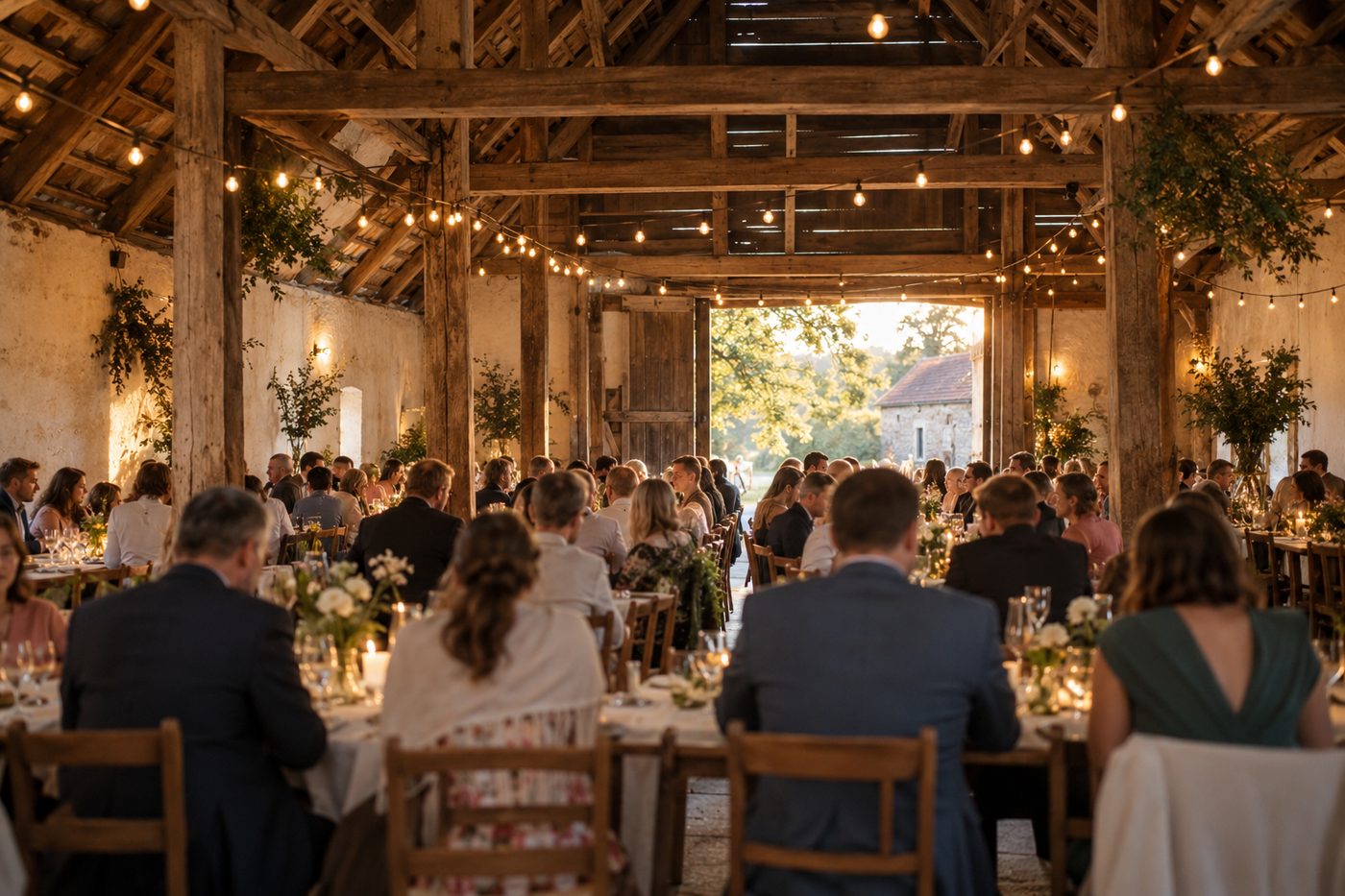 Long tables fit into narrower barns too and create a feast-like atmosphere.
How to show guests the seating plan
- A board at the entrance. Guests' names in alphabetical order, each with a table number or name. Alphabetical order is quicker than searching table by table.
- Name cards on the plates. Guests find their place at the table, and the staff know who is having which menu. You can discreetly mark a name card for a vegetarian or a children's meal.
- Tables with names. Instead of numbers, you can name the tables after flowers, cities you have visited together or favourite films. Then no table feels like "the last one".
What to give the venue and the caterer
- a floor plan of the hall with table numbers and the number of people at each,
- the guest list by table and separately in alphabetical order,
- dietary needs and allergies next to specific names,
- the number of children, children's menus and high chairs.
You can easily prepare all of this in the Svatbík seating plan. Guests come through from the guest list along with their RSVP and their group colour. You arrange the tables as they are in the hall, round or long, drag guests onto chairs and see at each table how many places are left. You print the finished plan or download it as a CSV for the coordinator and the caterer. The seating plan is part of Svatbík Premium.
Frequently asked questions
Does a wedding need a seating plan?
At a wedding of up to about 25 guests at one table, you can manage without one. For bigger weddings, we recommend it. Guests don't have to look for a seat, families sit together and the staff know who is having which meal.
Where do the parents sit at a wedding?
Either at the top table with the newlyweds or at their own tables right next to it. Both options are fine; what matters is that they are close.
Where should children sit?
With their parents. A children's table only makes sense for older children, and only right next to their parents' table.
How many people fit around a round table?
Eight people sit comfortably at a table 150 cm across, and ten at a table 180 cm across.
What if someone doesn't come at the last minute?
An empty seat at a table doesn't matter. Move the name card and let the staff know so they don't prepare an extra meal.
What to open next
Wedding venues on this topic
Related articles
- Wedding invitations: what to include, when to send them and ready-made wordingWhat a wedding invitation must include, when to send it and when to ask for RSVPs. Ready-made wording for the invitation, reception, gifts and no children.
- The wedding meal: plated menu or buffet, how much food and the price per personHow to plan the wedding meal: a plated menu or a buffet, three sample menus, how much food and drink to allow per guest and prices per person in 2026.
- Wedding day schedule: three templates for a morning, afternoon or late ceremonyReady-made wedding schedules for a ceremony at 11am, 2pm or 4pm: where to fit traditions, photos and speeches, how much slack to allow and how to share it.